October 16, 2026 · 2 hours ago
How to actually analyze customer feedback at scale
Deduplication, signal versus noise, taxonomy and thresholds, answered directly
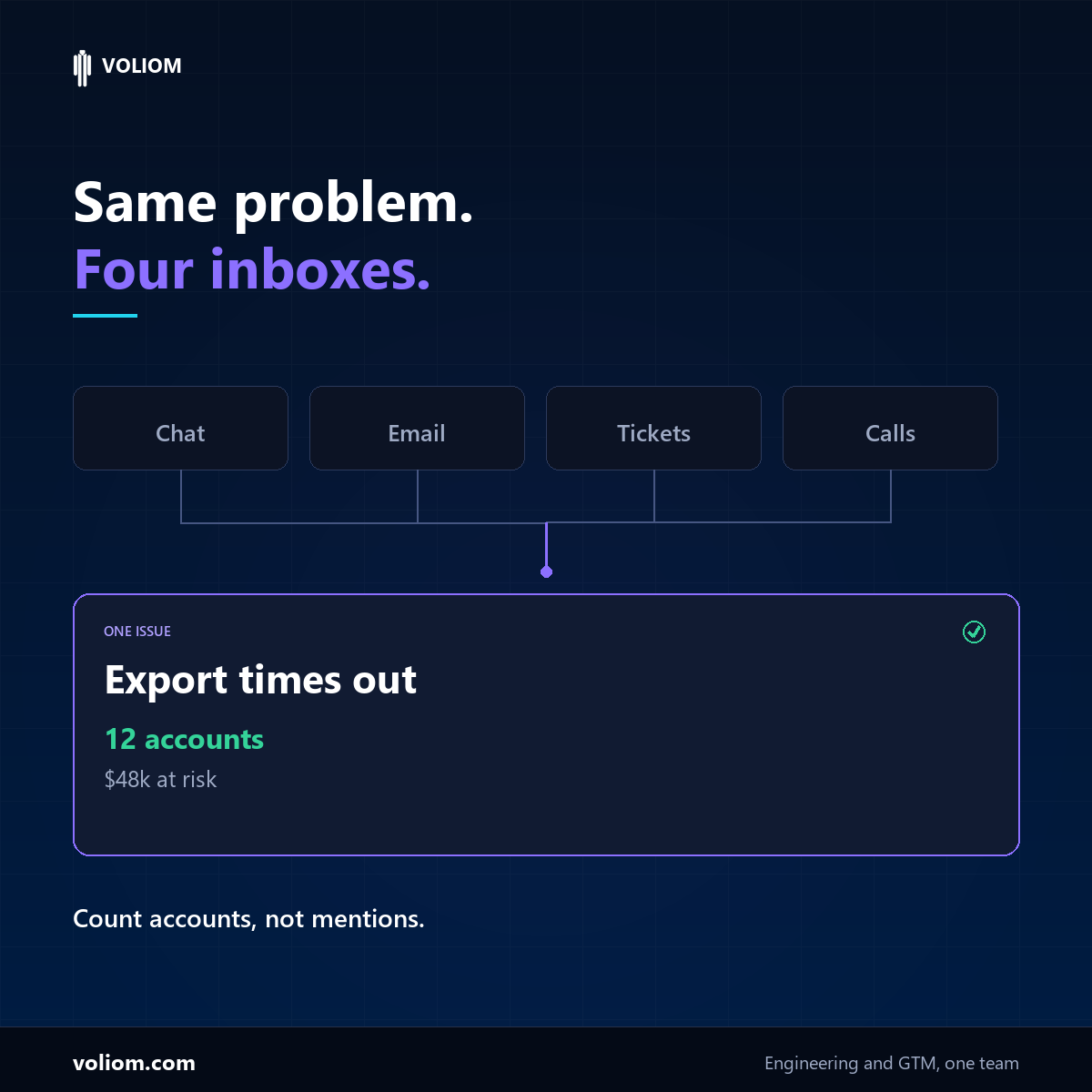
Someone asked how feedback analysis actually works at scale. Honest answer first: most companies do not have a system. They have a loud customer, a spreadsheet, and a product manager with a good memory. That works until it quietly stops.
Here is what the teams who do it properly do.
Deduplicate issues, not messages
The mistake is trying to merge tickets. You cannot, because the same problem gets described five different ways. What you merge is the issue underneath.
So you keep one canonical issue record and attach mentions to it. Matching is done on meaning rather than keywords, which means embedding similarity plus the account id, so one customer raising the same thing in chat and then in email lands on one record instead of two.
The counter that matters is distinct accounts, not messages. Ten emails from one frustrated admin is one account.
Signal is about who, not how loud
Stop counting mentions. Start counting accounts and revenue attached to them.
Three accounts in your ideal customer profile beats thirty from people who will never pay. A complaint that shows up in churn reasons or lost deal notes outranks anything in your inbox.
Things that look like analysis and are not: sentiment percentages, word clouds, and a chatbot summary that returns a different list every run. None tell you what to build.
Two axes, not a tree
Theme for the area of the product, type for what kind of feedback it is. Bug, missing capability, confusion, praise. Confusion is the one everyone forgets and it is usually a design problem wearing a support costume.
Keep it under about thirty themes. If more than five percent of feedback lands in other, your taxonomy is wrong, not your customers.
The threshold is weighted, never a count
A theme gets attention when one of three things is true. Enough distinct accounts, enough revenue at risk, or it appears in why someone left or why you lost a deal.
Any fixed number will mislead you, because ten mentions from free users and ten from your largest accounts are not the same event.
Thin evidence is a watch item, not a no
Never close it. Log it, attach a counter, and go look for behavioural proof. If two customers say a step is confusing, open the funnel and see whether people drop there. The data usually settles it in minutes.
One complaint from exactly the right customer is a leading indicator, not an outlier. And remember the quiet part: the users who are struggling most often say nothing at all. They just leave. Absence of feedback is not absence of a problem.
The thing nobody mentions
The bottleneck is almost never analysis. It is routing. If a theme does not have a named owner, you have built a very tidy archive.
We automate this for clients, usually by connecting the channels they already have rather than adding another tool nobody opens.
If this is your problem too
We build the software and the go-to-market behind it. Twenty minutes, no deck, and we will tell you if it is not worth doing.
Book a callLet's talk
Tell us what you're building.
Get a free 30-minute strategy call. You'll leave with a clear plan, a realistic estimate and our honest opinion — whether or not you work with us.
- Email usmail@voliom.com